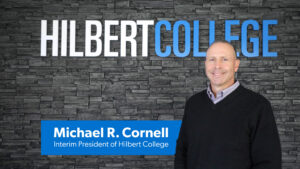
Read President Cornell's latest article, recently published in Buffalo Healthy Living Magazine. In "AI Won't Replace You. But Someone Who Knows How to Use It Well Might.," President Michael R. Cornell discusses how Hilbert's Institute for Applied Artificial Intelligence and new Bachelor of Arts in Artificial Intelligence Studies are preparing students to lead responsibly in an AI-driven workforce.
Every once in a while, someone asks me the same nervous question: “Is AI going to take our jobs?” I get the question, but I think we’re asking the wrong one. The right question is simpler, and harder. It’s not “whether AI can replace us,” but “who among us has learned use it well.” At Hilbert College, our Institute for Applied Artificial Intelligence and our new Bachelor of Arts in Artificial Intelligence Studies are built around ensuring that our students know how to use it well.
The fact is that artificial intelligence is unlikely to replace all human work. What it will replace is the person who wants to “sit this one out.” The nurse, the accountant, the teacher, the small-business owner in Hamburg or downtown Buffalo who learns to use AI well will outperform the one who doesn’t. So, at Hilbert College, our goal is to ensure our students are AI-fluent as a result of their degree program.
Here’s another thing we think about at Hilbert. If we ask the question “Can AI do this?”, the answer is nearly always yes. AI can draft your emails, analyze your health records, screen job candidates, even mimic your voice. Capability is no longer the limiting factor. Today, human judgment is.
The question that matters is this: Should we?
And if we should, how do we do it responsibly, with people and communities at the center?
That question can’t be answered by an algorithm. It requires leadership, ethics, and human wisdom. These are decision-making ingredients that Hilbert College’s Franciscan, humanities-rooted education has always cultivated.
That’s why Hilbert created our Institute for Applied Artificial Intelligence to be not another computer science lab focused just on the technology, but a human-centered, application-focused program that trains students and working professionals to use AI thoughtfully in real workplaces — from health care to nonprofits to manufacturing firms across Western New York.
This spring, we built on that foundation with the Bachelor of Arts in Artificial Intelligence Studies, a new on-campus program. Rather than train students purely in the technology, our program approaches AI through an interdisciplinary lens, examining its ethical, social, creative, and professional impact across business, media, health care, and public service. Students get hands-on time with industry-leading AI tools, but the real coursework is critical thinking, communication, and ethical decision-making — the judgment that determines whether a tool gets used wisely.
We are not preparing students to compete against artificial intelligence. More importantly, we are preparing them to lead at this complex time because of how well they understand that AI is about augmentation not automation. It’s not about the “can we?”, but the “how should we?”
No matter what it says on the diploma, every Hilbert degree is built, by design, to be a degree of courage. It’s the courage to be seen, tested, and challenged in small classes where you can’t hide, so that when the harder call comes, you’ve already practiced making it. It’s the courage to sit with a question that has no clean answer and still act. That kind of judgment can’t be automated by artificial intelligence, and building exactly that level of discernment is the actual work of a Hilbert education.
Hilbert College is preparing people for the world in which those who lead with courage, question incisively, and use these tools with conscience are the ones communities turn to.
AI can do almost anything we ask. Our job is teaching people how to ask the right questions first.
This article was originally published by Buffalo Healthy Living Magazine. Visit their site to read more health and lifestyle coverage from across Western New York.
Contact Us
-
Michael R. Cornell
Interim President


